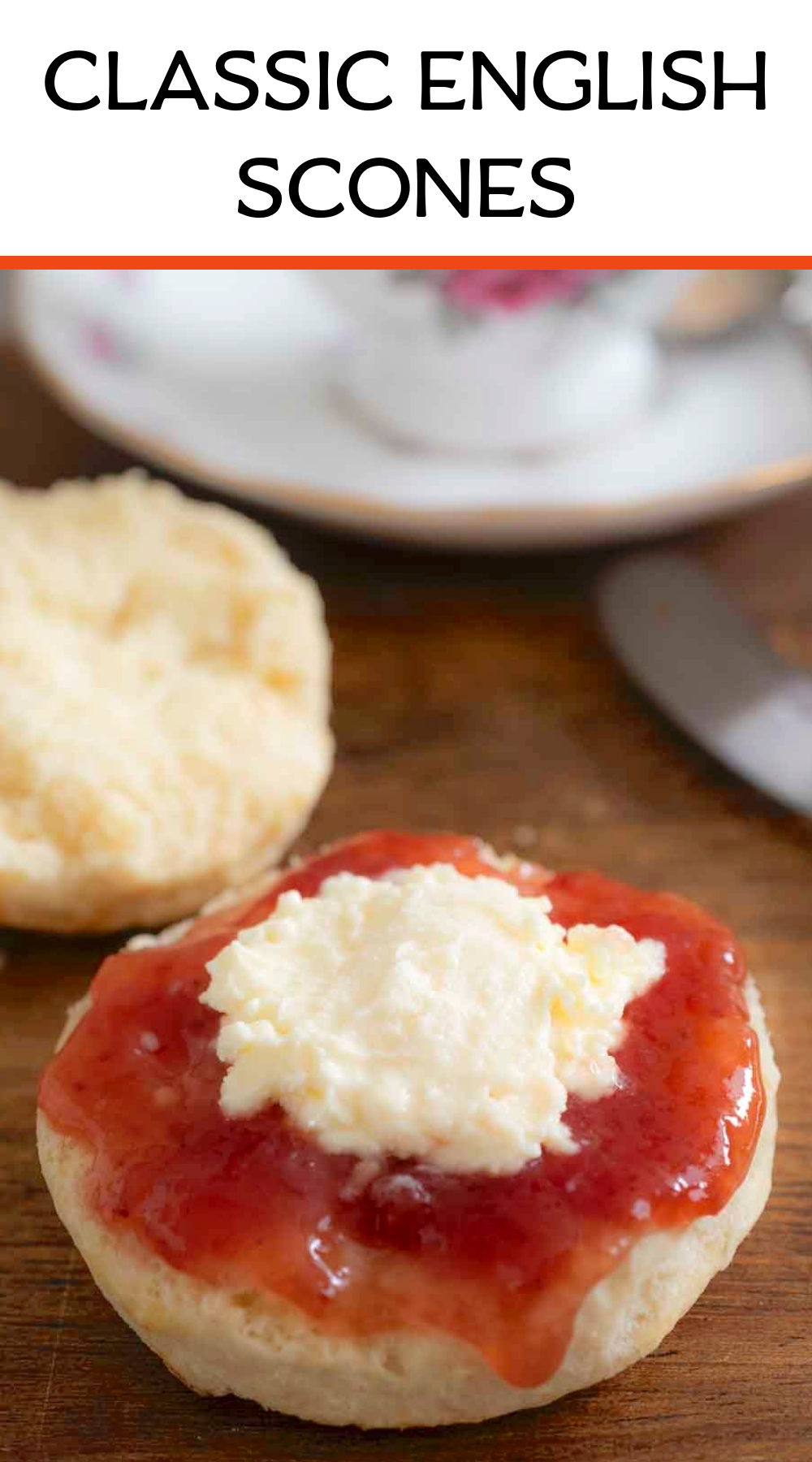

Classic English scones are light and airy with a slight crumble. This beloved British treat is easy to jazz up with fresh or dried fruit—or whatever tasty twist you fancy. They are usually served with afternoon tea and clotted cream. Made in the traditional British round version, different to the American triangle ones.

This popular recipe has been here since 2016, now with a few updated photos and a new video.
Contents
Ingredients
- All-purpose/plain flour
- Baking powder
- Salt
- Butter
- Eggs
- Milk
- Sugar
What is clotted cream?
While the name might not sound very appealing, this is the creamiest, richest cream made from the best Devon cows’ milk. How do you make it? Cook the cream on the stovetop or in the oven until it clots and forms a thick layer on top. Then simply skim off that luxurious layer and spread it on scones.
To read a more comprehensive history of clotted cream and afternoon tea (or cream tea), I have a more detail post on Clotted Cream for Afternoon Tea.
What is the texture of English scones?
English scones should be light and airy, with a soft, fluffy inside and slightly crumbly. They’re tender, yet not cake-like.

Are English scones like American biscuits?
English scones are a bit sweeter and denser, while American biscuits are flakier and more savory. They may look similar and share many of the same ingredients, but their flavors and textures set them apart.
In contrast, biscuits are usually served with savory dishes like gravy or fried chicken. They taste more buttery and have a flaky, layered texture.
English scones and American scones: How they compare
They are similar in that they’re both quick breads, but they have some key differences in texture, sweetness, and size:
English Scones:
- Usually lighter, fluffier, and less sweet
- Small and round shaped
- Often served with clotted cream and jam as part of a traditional cream tea
- Typically just a little buttery, not heavily sweetened
American Scones:
- Tend to be bigger, denser, and commonly in a triangle shape
- Often sweeter, with added ingredients like chocolate chips, fruits, or nuts
- Sometimes glazed or topped with icing
- More like a pastry or dessert treat
Cold butter is a must for scones
When making an English scone recipes, cold butter is key to achieving fluffy, well-risen results. The tiny, chilled bits of butter distribute evenly through the dough, then melt as the scones bake, creating a light and slightly crumbly texture.
Shaping and cutting scone dough
Shaping and cutting English scones is all about keeping them light and tender with a nice rise.
Here’s how to do it right:
1. Prepare Your Dough Gently – Mix your ingredients until just combined—overmixing develops gluten and makes scones tough.
2. Turn Out the Dough on a Floured Surface – Lightly flour your work surface and gently pat or roll the dough into a roughly 1-inch thick circle or rectangle. Don’t overwork it!
3. Cut Cleanly – Use a non-fluted, round cutter (about 2 to 3 inches wide). Press straight down firmly—don’t twist or turn the cutter, as twisting seals the edges and promotes even rising.
6. Arrange on Baking Tray – Place scones close but not touching on a lined baking tray. Leaving a little space helps them rise upwards rather than spreading out.
7. Brush with egg wash to help make the tops of the scones golden.

Serving English scones – jam or clotted cream first?
The big question is whether to spread jam first and then add the cream, or the other way around. Eat them however you like, but I prefer jam first, then cream—and that’s how the Queen enjoyed them too. It’s also easier to spread the jam directly onto the scone before topping it with a dollop of cream. Strawberry or raspberry jam (preserves) is traditional.
Sweet scone variations
These Classic English Scones are delicious on their own, but you can also mix in dried fruit like Autumn Apple and Date Scones, British Pumpkin and Currant Scones or fresh fruit like my Summer Strawberry Scones. Pictured below.


Savory scones
Not all British scones are sweet. There are endless ways you can make the savory. I recently made Cottage Cheese, Cheddar and Chive Scones which are so tasty (and an extra bit of protein). They are so good with butter served with a salad or soup in place of bread.
Make ahead scone dough
You can prepare the scone dough ahead of time—just wrap it in plastic wrap and refrigerate for up to 24 hours. f you need to store it longer, freeze the shaped scones instead—they’ll keep well for about 2–3 months and can be baked straight from frozen.
Cream scones
Cream scones are simply scones made with cream instead of milk. Personally, I don’t notice much difference in the result, so I use whole milk every time—the same goes for buttermilk.
Storing scones
Short-term (1–2 days)
- Cool completely after baking to avoid condensation.
- Store in an airtight container or wrap tightly in plastic wrap at room temperature.
- Avoid refrigeration because it can dry out the scones and make them too crumbly.
Longer-term (up to 1 month)
- Once completely cooled, wrap each scone individually in plastic wrap or foil.
- Place the wrapped scones in a freezer-safe bag or airtight container and freeze.
- To reheat, thaw at room temperature and warm gently in the oven (around 300°F/150°C for 5–10 minutes) or toaster oven to restore freshness.
You can also FOLLOW ME on FACEBOOK, TWITTER, INSTAGRAM and PINTEREST to see daily recipe updates.
Prep Time
15 minutes
Cook Time
20 minutes
Total Time
35 minutes
Ingredients
- 2 cups (260 grams) all-purpose flour
- 2 teaspoons baking powder
- ½ teaspoon salt
- 5 tablespoons (2 ½ ounces/70 grams) unsalted butter, cold, cut into small pieces
- 2 large eggs, room temperature
- ¾ cup (180 ml) plus 1 teaspoon milk, room temperature
- 2 tablespoons granulated sugar
Instructions
This recipe yields 6 scones
- Preheat oven to 425°F/220°C. Line a baking sheet/baking tray with parchment/baking paper.To a mixing bowl sift the flour, baking powder and salt, mix well. Grate the butter into the flour and using your finger tips to rub the butter into the flour (see video for technique) until it forms large crumbles.
- To a mixing bowl sift the flour, baking powder and salt, mix. Add the butter to the flour and use your finger tips to rub the butter into the flour (see video for technique) until it forms large crumbles. Tip: Gently shake the bowl back and forth—any larger pieces of butter will rise to the top, making them easier to spot and break down.
- In a separate bowl, whisk 1 egg into ½ of the milk. Make a well in the center of the flour and add the egg/milk mix and sugar. Mix the dough lightly with a fork until it comes together adding a little more milk as you mix (you may not need it all). It should be moist, but not sticky and just holding together.
- Turn the dough onto a lightly floured cutting board. Flatten and fold the dough so the top is smooth without cracks. Shape the dough to ¾-inch (2 cm) thick round. Do not work the dough too much and do not use a rolling pin.
- Using a non-fluted 2 ½ inch (5 cm) cookie cutter, dipped in flour, cut rounds pressing straight down, do not twist. Dip the cutter into flour before each cut.
- Whisk the remaining egg with the 1 teaspoon milk and brush the tops of the scones. Bake for 15-20 minutes or until lightly golden brown.
- Remove from the oven, transfer to a wire rack to cool completely. Cover with a clean, dry towel while they cool to keep them moist.
- Storing scones: Store them in an airtight container at room temperature for up to 2 days. For longer storage, refrigerate them for up to 5 days—just warm them in the oven or toaster before serving. You can also freeze them for up to 3 months; thaw at room temp and reheat in a warm oven to refresh.
Nutrition Information
Yield
6
Serving Size
1
Amount Per Serving
Calories 287Total Fat 12gSaturated Fat 7gTrans Fat 0gUnsaturated Fat 4gCholesterol 90mgSodium 374mgCarbohydrates 37gFiber 1gSugar 4gProtein 7g
This nutrition calculation is provided by Nutronix that is only a guideline and not intended for any particular diet.

Janette is a professionally trained chef based in California who channels her passion for cooking into thoughtfully crafted recipes. Her culinary creations are inspired by her English heritage as well as her favorite global cuisines, including Indian and Italian. Connect with her on Facebook, Pinterest, and Instagram for more delicious inspiration. More About Janette…
Resep Makanan
Berita Olahraga
News
Berita Terkini
Berita Terbaru
Berita Teknologi
Seputar Teknologi
Drama Korea
Resep Masakan
Pendidikan
Berita Terbaru
Berita Terbaru
Berita Terbaru